- The boardroom noticed before marketing got ready
- Marketers can feel the shift, but can't act on it
- Most teams are flying without a map
- Leaders think their teams are further along than they are
- The AI is also getting your story wrong
- What separates the teams seeing results
- Your agency might be the bottleneck
- Where to start this quarter
A buyer evaluating your category opened a chatbot last week, typed in their problem, and read back a list of three vendors. Maybe you were on it. Maybe a competitor was, described in flattering detail while your name never came up. Maybe the AI mentioned you but got your product wrong, placed you in the wrong category, or quoted positioning you abandoned eighteen months ago.
You will probably never know which of those happened. That is the problem Compass's 2026 GEO and AI Visibility Survey of 150 U.S. B2B tech marketers puts numbers to. The numbers are not comfortable.
"Providers need to evolve from driving traffic through search engine optimization to driving visibility through answer engine optimization." — Forrester, B2B Buyers Make Zero-Click Buying Number One
LLMZap fires real prompts at Perplexity, Gemini, ChatGPT, and Claude — the same queries your buyers type — and shows you exactly whether and how you're cited. No guessing.
Run a free AI visibility scanThe boardroom noticed before the marketing team got ready
Buyers are already using AI as a vendor-research layer. Responsive's 2025 Inside the Buyer's Mind study found that two-thirds of B2B buyers rely on AI chatbots as much as or more than Google or Bing when evaluating vendors; in technology and software the share reached 80 percent.[1] Forrester's 2026 business-buying research found that 94 percent of B2B buyers use AI during the purchase process and named generative AI or conversational search as a more meaningful information source than any other option.[2]
Boards and CEOs have caught on. In Compass's survey, 88 percent of senior marketing leaders said leadership or the board had asked what they were doing to show up in AI answers.[3]
That question lands on teams that mostly cannot answer it. Across all marketers, 34 percent said they had a defined strategy and felt prepared to shape how AI engines describe and recommend their brand. Another 43 percent were running informal efforts with no real plan. Even among CMOs and VPs, only 52 percent claimed a defined approach.
Marketers can feel the shift, even if they cannot act on it
Ask these teams what matters most in 2026 and brand awareness tops the Compass list at 44 percent, ahead of lead generation. That would have sounded strange a few years ago. It makes sense in an AI-mediated buying journey.
When a buyer asks a model which vendor to consider, the model pulls from years of accumulated signals: editorial coverage in trusted outlets, analyst citations, thought leadership, clear entity data, and a brand that shows up consistently across the places it reads. A company with thin coverage gives the model little to work with.
Muck Rack's May 2026 What Is AI Reading? study makes the mechanism visible: after analyzing more than 25 million links cited by ChatGPT, Claude, and Gemini, it found that earned media accounted for 84 percent of AI citations, while paid and advertorial content accounted for just 0.3 percent.[4]
"About 84% of citations come from earned media." — Muck Rack, What Is AI Reading? May 2026
One of LLMZap's 14 check categories scores your Experience, Expertise, Authoritativeness, and Trust signals — about pages, contact info, author bios, expert quotes, and the entity signals that make a source worth citing. Fix these first and you directly improve your odds of being in that 84%.
See all 14 check categoriesMost teams are flying without a map
Half the marketers surveyed by Compass pointed to limited internal GEO expertise as their biggest obstacle. Four in ten cited poor coordination across content, PR, and web teams. About a third struggled to measure results.
Centerfield's 2025 Gen-AI Search Readiness Survey found that 63 percent of marketers were not investing time, budget, or staff in GEO, and that only about one-third reported good or expert understanding of GEO compared with 72 percent for SEO.[5]
The knowledge gaps are sharp. Only 36 percent of Compass respondents knew which content pieces — theirs or a competitor's — AI engines cite in their market. Just 26 percent knew which outlets those engines crawl. Fewer than three in ten actively tracked their AI visibility at all.
LLMZap's AI Visibility Tests fire real queries at Perplexity, Gemini, ChatGPT, and Claude, then return per-model citation rates and a per-prompt breakdown showing exactly which queries triggered a citation — and which didn't. Add competitor domains and you get a side-by-side comparison and a Gartner-style positioning map.
The ownership question reveals the confusion. Asked who should run GEO internally, 47 percent picked digital marketing and SEO. Only 17 percent named PR and communications. That instinct treats AI visibility as a technical tuning job, when the evidence increasingly points to brand authority, third-party validation, and credible mentions as core inputs.
Ahrefs' 75,000-brand study found that branded web mentions had the strongest relationship with AI Overview visibility among the factors it tested — much stronger than backlinks.[6] Stacker and Scrunch found that distributing content through earned-media channels produced a 239 percent median lift in AI search visibility in a 30-day study.[7]
Leaders think their teams are further along than they are
The Compass survey split senior leaders from the directors and managers who do the daily work — and the two groups described different companies.
Among CMOs and VPs, 59 percent said they felt very confident in their PR and content strategy and its effect on AI visibility. Among the practitioners executing that strategy, 37 percent agreed. Senior leaders were roughly twice as likely as their teams to say the company knows which channels influence models, which outlets the engines crawl, and which third-party sources those engines trust.
That matters because the market is moving fast. Walker Sands' 2026 B2B AI Search Visibility Benchmark analyzed nearly 45 million relevant search keywords across 828 enterprise B2B companies and found that AI Overviews appeared on nearly half of the relevant results pages where those brands ranked. But the typical enterprise B2B brand was cited in only a small share of relevant AI-generated answers.[8]
"Ranking breadth alone doesn't predict citation inclusion." — John Fairley, SVP at Walker Sands
LLMZap generates a structured score across 14 categories — Traditional SEO, Structured Data, E-E-A-T, Content & Answer Extraction, Entity Understanding, Hallucination Resistance, and more. Export a PDF management summary and share it up the chain. Everyone looks at the same number, not a different mental model.
Scan and export PDF report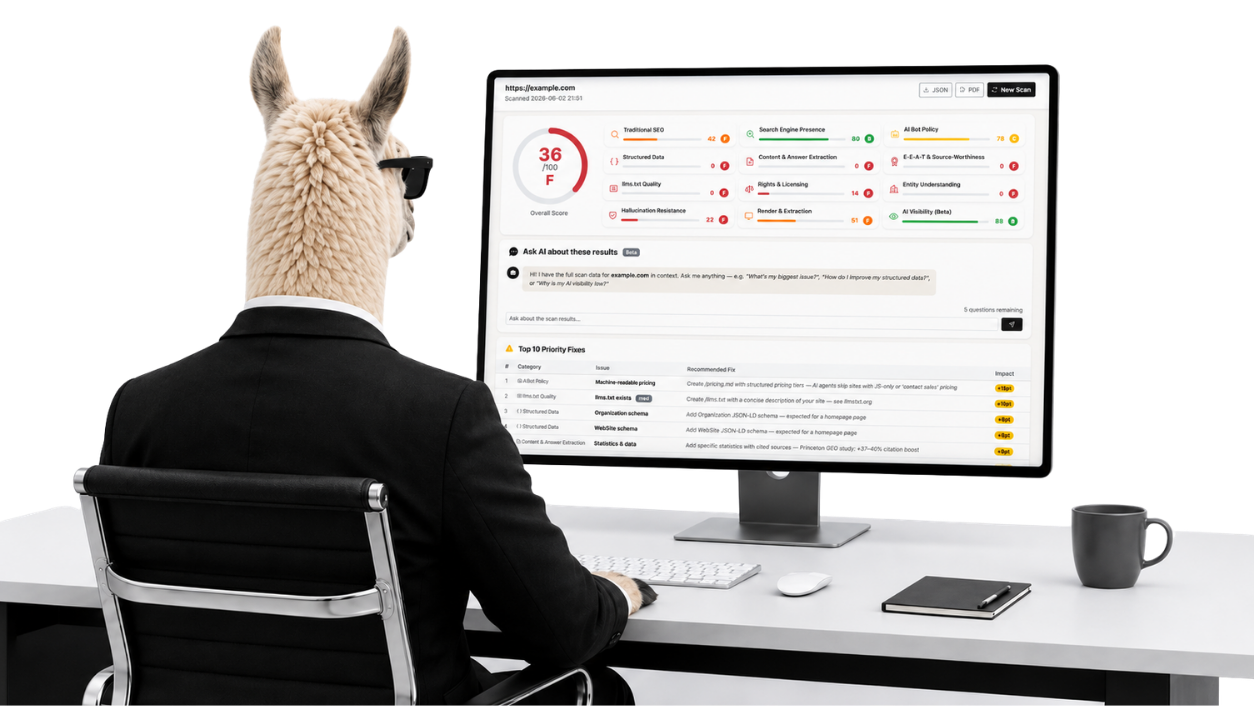
The AI is also getting your story wrong
Discoverability gets most of the attention. There is a quieter risk that hits just as hard. Nearly three-quarters of Compass respondents had watched an AI tool describe their company, category, or value proposition in ways that were wrong, stale, or incomplete.
Gartner's 2026 B2B buyer survey found that 45 percent of buyers used GenAI in a recent purchase, primarily to gather information on vendors and products — while 69 percent preferred to validate AI-generated insights with sales reps.[9] A buyer who gets a wrong answer about you may decide you're not a fit and never visit your site to find out otherwise. You lose the deal before you know there was one.
The Tow Center for Digital Journalism tested eight AI search engines across 1,600 queries and found that the systems failed to retrieve correct information more than 60 percent of the time.[10] Brands going through a pivot or a category-creation push face the sharpest version of this: the signals the models learned from may describe a company that no longer exists.
Two dedicated check categories address this directly. Hallucination Resistance checks whether your service area, pricing model, and key facts are explicit enough to leave no gaps for AI to fill in. Entity Understanding checks that your brand name is consistent and that you have sameAs links to LinkedIn, Wikidata, and Crunchbase — the anchors that help AI systems model your organisation accurately.
The AI Visibility Tests also show you what the AI currently says about you — so you can catch and correct wrong framing before it costs you a deal.
Check what AI says about your siteWhat separates the teams seeing results
AI visibility is already producing pipeline for the companies that took it seriously. In the Compass survey, 40 percent of marketers reported that visibility in AI search and chatbots lifted qualified inbound pipeline by 5 to 10 percent over the past year. Another 19 percent saw growth above 10 percent. Nearly six in ten reported measurable impact.
Strategy sorts the two groups cleanly. Of the marketers reporting flat or declining pipeline, 6 percent had a defined plan. Of those seeing growth, 53 percent did. Among the no-growth companies, 38 percent described themselves as still dabbling. Among the growth group, 7 percent did. And among the pipeline-growth group, 55 percent knew which channels carried the most influence over models in their market. Among companies seeing no impact, 15 percent did.
Seer Interactive reported that AI-referral traffic converted at higher rates than Google organic traffic in a B2B SaaS case study — while noting that absolute volume is still much smaller than organic search.[11]
The 40-point knowledge gap between pipeline leaders and laggards is not about budget — it is about intelligence. LLMZap gives you that intelligence in minutes: your citation rate per AI engine, which prompts triggered a citation, how you compare against up to five competitors, and a prioritised fix list sorted by impact weight.
That is the map the 55% have. The 15% are guessing.
Your agency might be the bottleneck
If you outsource PR, this part deserves a hard look. Only 37 percent of Compass respondents said their agency was prioritizing AI visibility and building it into strategy. Forty-five percent said the agency had raised the topic and was trying but lacked the expertise to make a difference. Among companies not seeing pipeline growth, half described their agency exactly that way.
Muck Rack found that only 2 percent of the journalists PR teams pitch overlapped with the journalists most cited by AI engines — a painful mismatch for teams that still measure media relations only by human readership or domain authority.[12]
Spend that flows to an agency that cannot tell you which publications the engines crawl, which journalists cover the topics models prioritize, or how to engineer coverage that builds authority is spend that gets your name in front of human readers while doing little for how machines understand you.
Before you renew a retainer, run an LLMZap scan and bring the results to the meeting. Ask your agency to explain the citation rate, which prompts missed, and why. Vague reassurance without evidence is an answer in itself. LLMZap gives you a vendor-neutral, objective baseline that no agency can spin.
Get your objective baselineWhere to start this quarter
Run your own audit first. Type your company name, your category, and your main differentiators into the major chatbots and write down what comes back. If the answers are wrong, treat that as a live pipeline risk, not a curiosity.
Then commit to a strategy built on your specific market rather than generic best practices. Learn which channels and sources actually move the models in your space. Put PR and thought leadership at the centre of the plan instead of the edges. Set up shared accountability across content, PR, SEO, and web so they work from one playbook and one set of metrics.
Your buyers are already asking AI which vendor to pick. The teams pulling pipeline out of that moment are not lucky. They mapped the territory, fixed what the models got wrong, and built authority in the places those models trust. The ones still waiting are handing the recommendation to whoever did the work.
Run your audit in 60 seconds
LLMZap checks your site across 14 AI-readiness categories — structured data, E-E-A-T, hallucination resistance, bot policy, and live AI citation tests. The basic scan is free. No account required.
[1] Responsive, Inside the Buyer's Mind, 2025; Digital Commerce 360 coverage.
[2] Forrester, The State Of B2B Buying, 2026.
[3] Compass, 2026 GEO and AI Visibility Survey, n=150 U.S. B2B tech marketers.
[4] Muck Rack, What Is AI Reading?, May 2026. Analysis of 25M+ AI-cited links.
[5] Centerfield, Gen-AI Search Readiness Survey, 2025; reported by Search Engine Land.
[6] Ahrefs, large-scale study of 75,000+ brands and AI Overview visibility, 2025.
[7] Stacker & Scrunch, 30-day earned-media AI visibility study, 87 stories, 30 clients, 2,600+ prompts.
[8] Walker Sands, B2B AI Search Visibility Benchmark, 2026. ~45M keywords, 828 enterprise B2B companies.
[9] Gartner, B2B Buyer Survey, 2026.
[10] Tow Center for Digital Journalism, AI search accuracy study, 8 engines, 1,600 queries.
[11] Seer Interactive, B2B SaaS AI-referral traffic case study, 2025.
[12] Muck Rack, What Is AI Reading?, May 2026. PR pitch/AI citation journalist overlap analysis.